
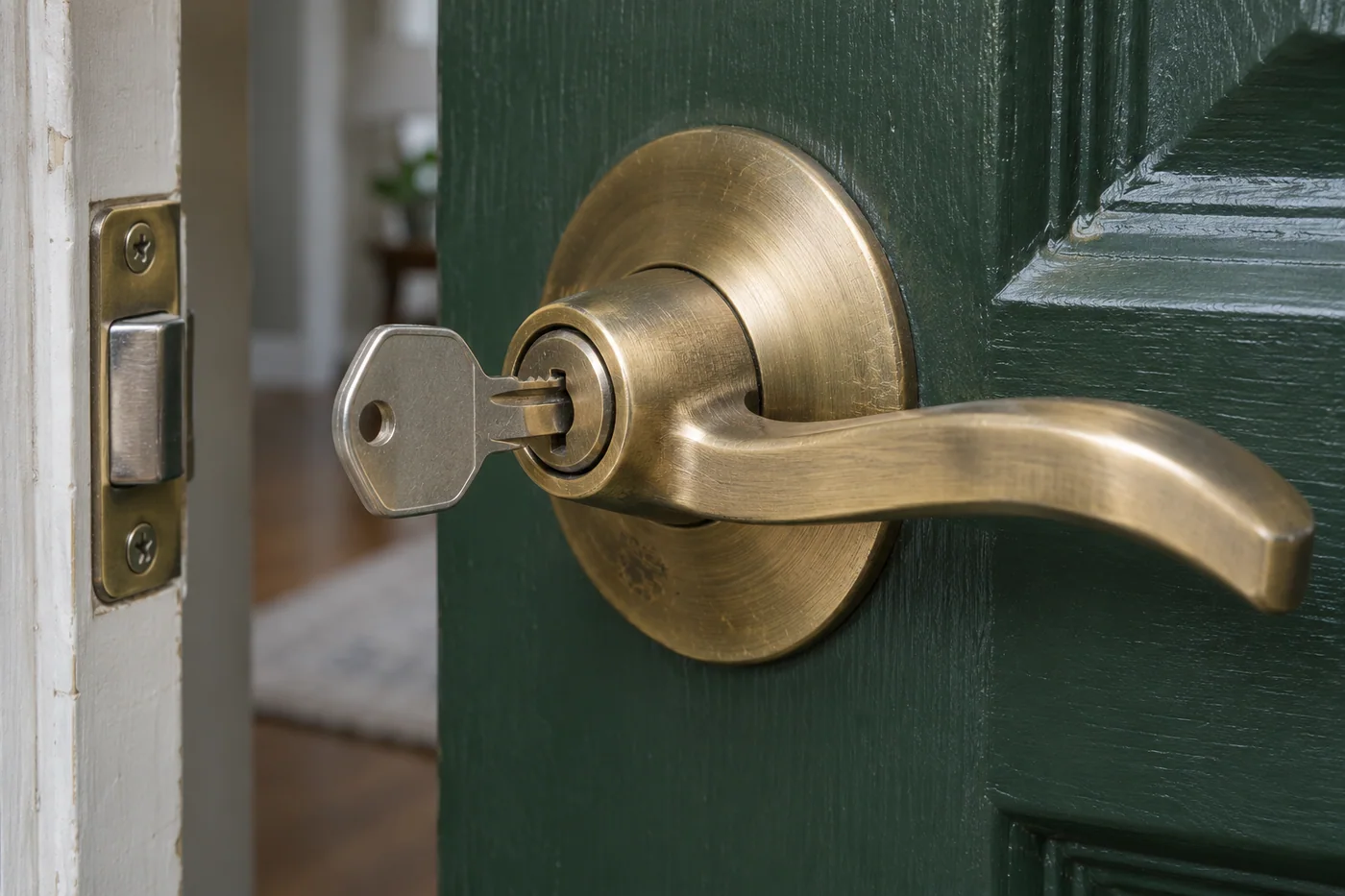
The key turns and the entrance opens, but the key will not come back out. That can be confusing because part of the lock seems to work. The first useful question is whether you are seeing a new fault or a feature of that particular hardware.
LockReach's guide helps you describe a key stuck in a door lock. It is not an extraction procedure. You do not need to pull harder, take the lock apart or change how the entrance works to gather enough information for a repair request.
Is the whole key still there?
Say whether the complete key is retained or whether a piece has broken off inside. If you have part of the key in your hand, describe that. A broken fragment and a whole key held by the lock are different starting points, even though both may be called a stuck key.
Next, explain what already happened: whether it turned, whether the door opened and whether the key remained in place afterward. Avoid force or repeated attempts. You can give a useful account without finding the exact point where something gives way.
Was it designed to stay in place?
Some hardware retains a key in a particular operating state. Kwikset documents key retention while unlocked on the SmartCode 955. That is a model-specific example. It is not evidence that an unknown lock, or a lock that suddenly behaves differently, is working as intended.
A model name, a manual and the account of someone familiar with the door can help establish the intended function. Ask whether this key used to come out in the same situation. If the entrance belongs to a workplace or managed building, the person responsible for it may know why that hardware was chosen.
Did the behavior follow other work?
Mention a recent rekey, cylinder replacement or other change, along with when you first noticed the problem. That timing is useful; it does not prove that the earlier work caused it. Keep any model details and description of the completed job.
Manufacturer rekey procedures apply to particular equipment and include their own preparation and testing requirements. They should not be borrowed as a general cure for a retained key. If the key-access arrangement is also being changed, discuss that separately from the physical lock repair.
Can the entrance still be secured?
Tell the provider whether the door is open or closed and whether it can still be locked as intended. A key exposed at an outside entrance or an entrance that cannot be secured changes the urgency of the request. If there is immediate danger, contact emergency services.
For a shared door, identify who can authorize work. Permission to use the key may not include permission to replace the cylinder or alter the lock function. Our commercial locksmith information covers that distinction for managed entrances.
Call 747-202-1211 to discuss the actual address and hardware. The useful goal is clear: establish the intended operation, assess the fault if there is one, and agree on how the entrance should work afterward.
A FEW DIRECT ANSWERS
Questions about
this request.
If the door opens, is it safe to ignore the retained key?
Opening the door does not answer whether it can be secured or whether the behavior is intended. Check those points, especially if the key is exposed to other people.
Will a new key solve it?
That cannot be established from key retention alone. Describe the condition of the key, the lock model if known and whether the same behavior occurred before.
Can the key-retention feature simply be removed?
A change must suit the exact hardware, the entrance and its required operation. Ask the responsible owner or manager before changing a function on shared or workplace equipment.
References: Kwikset cylinder/latch support / Kwikset SmartKey rekey instructions. Reviewed November 10, 2026. Product examples are model-specific; local references do not imply affiliation.